A Legacy of Faith, Founders, and Freedom
July 7, 2026 is the 250th birthday of the United States of America. As America marks this anniversary in 2026, the semiquincentennial of the Declaration of Independence, we stand at a pivotal moment to reflect on our nation’s enduring spirit.
This milestone isn’t just a historical footnote—it’s a call to renew our commitment to the principles that birthed the United States: faith, freedom, and a merit-based society where hard work and virtue propel individuals forward.
At Faithful Christian College (FAITHFL), we believe this celebration is an opportunity to honor God’s hand in our history, from the faith of George Washington and the Founding Fathers to the patriotic awakening sweeping states like Florida. By embracing these roots, we can inspire a new generation to know, cherish, and defend our heritage.
The story of America’s founding is woven with faith. The Founding Fathers, drawing from Judeo-Christian values, crafted a republic grounded in liberty under God.
Our rights come from God, not the state.
These men were orthodox Christians whose beliefs shaped the nation’s framework. The documents, they labored over, from the Declaration’s appeal to “the Laws of Nature and of Nature’s God” to the Constitution’s protection of religious freedom, reflect a deep reliance on divine providence. This wasn’t just rhetoric; it was a conviction that faith fosters moral virtue essential for self-governance.
George Washington
Happy President’s Day, by the way. Fun fact: The actual holiday is called, George Washington’s Birthday.
Central to the American narrative is George Washington, the Father of Our Country, whose life exemplified faith in action. Washington was a devoted Anglican, serving as a vestryman in Truro Parish and attending church regularly.
His writings and actions reveal a man who communed with God privately, avoiding public displays but acknowledging divine intervention, often. During the harsh winter at Valley Forge in 1777-1778, Washington was reportedly seen praying alone in the snow, seeking strength for his beleaguered troops. This iconic moment, captured in Arnold Friberg’s famous painting, symbolizes how faith sustained him through trials.
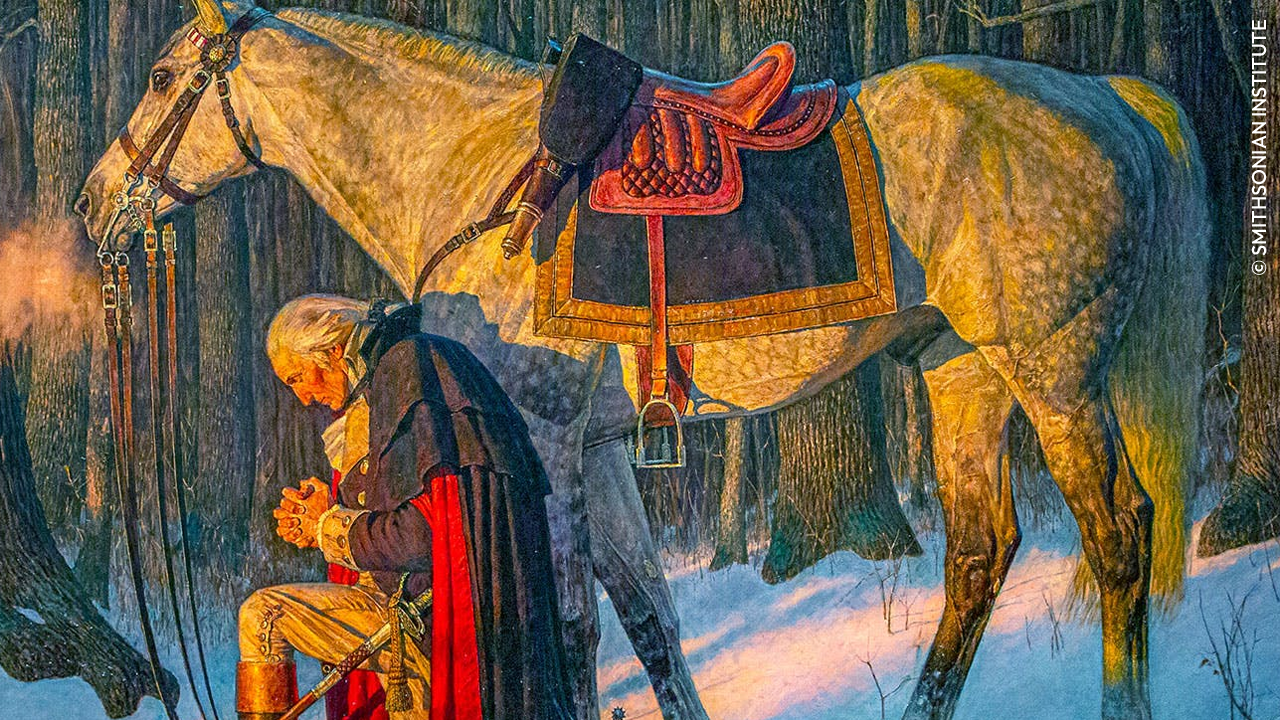
Washington’s faith wasn’t passive—it guided his decisions, including his historic rejection of kingship.
After the Revolutionary War, whispers of monarchy swirled. In 1782, Colonel Lewis Nicola wrote to Washington suggesting he become king, arguing a strong central figure was needed. Washington’s response was swift and severe: he viewed the idea with “abhorrence” and reprimanded Nicola harshly.
Later, at war’s end, he resigned his commission to Congress in Annapolis, bowing humbly and returning to private life—a move that stunned King George III, who called him “the greatest man in the world.”
This act of humility echoed biblical teachings on servant leadership, rejecting earthly crowns for republican ideals. Washington’s faith-driven restraint ensured America remained a land of the people, not a monarchy, setting a precedent for peaceful power transitions.
The broader Founding Fathers shared this ethos. Figures like John Adams, Benjamin Franklin, and Thomas Jefferson infused their work with religious wisdom, even if their expressions varied. Adams declared Christianity the “religion of the founders,” knowing it will endure.
Franklin proposed prayer at the Constitutional Convention, reminding delegates that “except the Lord build the House, they labour in vain that build it.” Their collective faith—rooted in Scripture—fueled the Declaration’s assertion of unalienable rights endowed by the Creator.
“Except the Lord build the House, they labour in vain that build it.”
—Benjamin Franklin
This spiritual foundation birthed American meritocracy: the belief that success stems from talent, effort, and virtue, not birthright. Meritocracy’s roots trace to the Protestant work ethic, emphasizing diligence as a sign of divine favor. Thomas Jefferson envisioned a “natural aristocracy” based on merit, advocating education to identify and elevate the talented from all classes.
Tied to faith, meritocracy reflects biblical parables of stewardship, urging us to use God-given abilities for the common good.
Today, as we celebrate America’s 250th, these themes resonate in nationwide initiatives.
The America250 organization, a nonpartisan effort backed by Congress, aims to engage all 350 million Americans in reflecting on our past and future. Programs like “America’s Field Trip” encourage students to ask, “What does America mean to you?” through art and essays, while “America Gives” promotes volunteerism as the largest service year in history.
In Florida, Governor Ron DeSantis has launched “America 250 Florida” celebrations, highlighting the state’s role in our founding. From art exhibits like “250 Years of Florida Art” to historical reenactments and statue unveilings of founders like Washington and Jefferson, the initiative ties education to patriotism.
Video begins at 14:45
Events include lectures on the Revolution, festivals, and even a Second Amendment sales tax holiday, emphasizing constitutional rights.
As we approach America’s 250th anniversary, the call to celebrate is also a solemn charge to remain vigilant and watchful. Our nation faces assaults from every direction—cultural erosion, moral confusion, external threats, and internal divisions that seek to undermine the very foundations upon which this republic was built.
In such times, we must actively return to our roots: faith in God, the strength of family, and unwavering love for country.
George Washington’s heartfelt prayers at Valley Forge remind us that divine guidance sustained our forebears through the darkest hours, and it remains our surest source of strength today. The Founding Fathers, when they signed the Declaration of Independence, pledged their lives, fortunes, and sacred honor under the providence of the Creator—a covenant we are called to renew in our own generation. Only by recommitting to these timeless pillars—God as our ultimate authority, family as the bedrock of virtue and citizenship, and country as a blessing worth defending—can we preserve this republic for those who come after us.
Let this year not be remembered merely as a milestone of pageantry, but as a decisive turning point: a moment when we faithfully teach our children the truth of our history, instill in them a living faith, and equip them to stand firm against every challenge.
As Benjamin Franklin cautioned at the close of the Constitutional Convention, we have “a republic, if you can keep it.”
With God’s help, vigilant hearts, and resolute patriotism, we will. In returning to these roots, we honor the past, secure the present, and ensure a future where liberty, under God, endures. God bless America—and may America once more bless God with grateful and steadfast devotion.
America 250 celebrates our Anniversary at https://america250.org/
Celebrate with State of Florida at https://america250fl.com/
Leave a Reply
You must be logged in to post a comment.